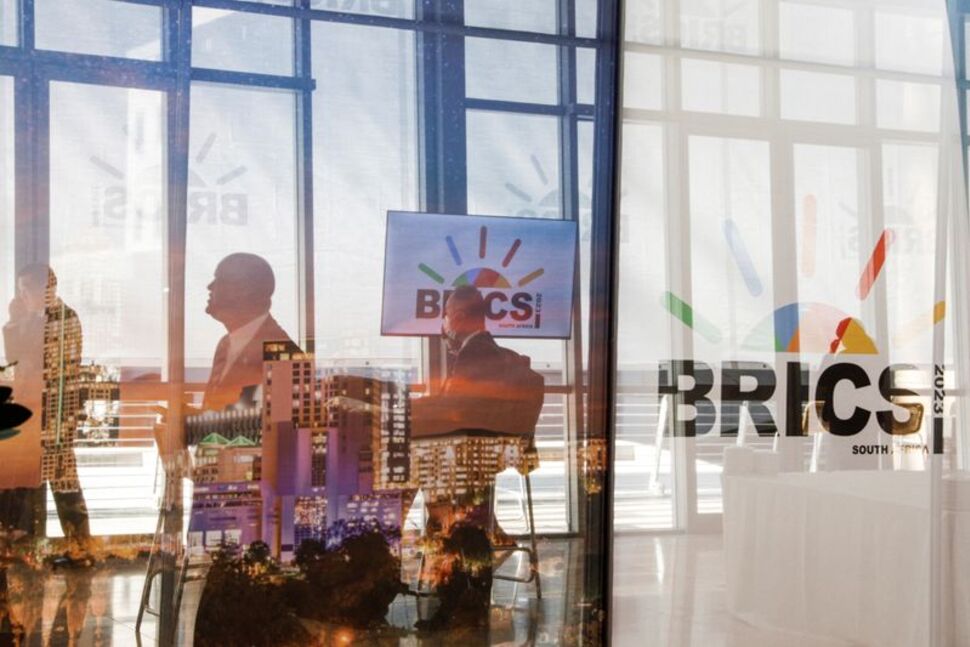
The BRICS group of countries—Brazil, Russia, India, China and South Africa—has agreed to admit six new countries to the group, significantly including the oil states Saudi Arabia, United Arab Emirates and Iran. The stage is now set for the new group to make a really game-changing challenge to dollar supremacy and U.S.A. hegemony, which go hand in hand.
While they have said nothing public about their intentions, it will surprise me if they do not, in the foreseeable future, create a modern version of John Maynard Keynes’ 1945 proposal to form a Clearing Union, which would replace the dollar as the predominant source of liquidity for financing international trade. In Occupy World Street (Jackson, 2012)2 , I mentioned this institution as one of eight new institutions that could form the basis of a new world order for a sustainable future, and described it in great detail. In the event, though Keynes’ proposal was far superior, the U.S.A. was in a much stronger negotiating position in 1945, and insisted upon an inferior gold-linked dollar system, which lasted just 26 years before it was disbanded in 1971 for lack of gold.
The special feature of Keynes’ ingenious proposal is that it treats all countries as equals, while eliminating the need for liquidity to finance international trade. Instead, trade is financed by a debit/credit system, where trade surpluses and deficits for each member country are registered by a new currency of account (and only a currency of account—i.e. not a medium of exchange and not a store of value), which I called the “eco” and Keynes called the “bancor”. As long as the surpluses and deficits remain within agreed limits, there in no need to exchange cash. If a country gets too far into debit or credit, then interest charges kick in, which force the offending country to modify its trade policy and/or exchange rate and get back into the agreed zone. The interest received could be put into a fund for the common good for, say, mitigating environmental damage. In addition, creating a Clearing Union would free up many billions of dollars now held as Central Bank Reserves and make them available for more constructive purposes.
Keynes suggested that the bancor could be based on the value of a basket of commodities. I think that would lead to unwanted volatility as commodities often move together. My suggestion for the eco was rather a basket of currencies, which would be more stable.
The decline in dollar supremacy would come about because the U.S. would no longer have the ability to purchase anything it wants with its own currency, confident that the dollars spent would often be held as Central Bank Reserves to finance trade rather than be sold. Furthermore, as a non BRICS-member, the U.S would have to open an eco account with the Clearing Union in order to trade with a BRICS member. This could only be done by depositing foreign currency, and not dollars. This could have wide-ranging consequences for purchasing oil. With Saudi Arabia, the U.A.E. and Iran joining Russia, and Venezuela as a likely future member, the BRICS countries would dominate the oil market.
I did not forsee the BRICS countries taking a Clearing Union initiative a decade ago, but rather hoped a group of smaller countries might do so, along with the other seven institutions, that included more democratic replacements for the World Bank, IMF and WTO. But it now looks like a very natural thing to do for the BRICS group, which is already working on new non-American-dominated versions of the above-mentioned three institutions.
1Originally published in Danish by the online platform POV International, August 31, 2023 . See https://pov.international
2J. T. Ross Jackson, Occupy World Street: A global roadmap for radical economic and political reform. (Chelsea Green, 2012).
 J.T. Ross Jackson
Leave a comment