
I mentioned in my recent blog 34 Trillion in Debt is NO PROBLEM! that an ever-increasing national debt is, in fact, necessary to prevent the production sector from collapsing from an overload of debt. I wrote that I could prove this with a very simple chart that a 12-year-old can understand. So, what follows is how I would explain this fact to a 12-year-old ☺
To start with, I will introduce a powerful visual concept from “sector economics”. A national economy can be understood as consisting of a small number of sectors that send cash back and forth to each other in a closed system. A useful way to illustrate this is to define the five major sectors and the net surplus of each, i.e. cash in minus cash out:
| SECTOR | SURPLUS |
| Households (H-sector) | Income – Consumption |
| Production (P-sector) | Cash Profits- Investment |
| Banks (B-sector) | Interest Earned – Interest Paid |
| Government (G-sector) | Taxes – Spending |
| Foreign (F-sector) | Imports – Exports |
Note that no cash can be lost. Therefore, the surpluses must add up to zero. A negative surplus is called a deficit. In any given year, we can represent the surpluses in a chart such as the following in billions of dollars.
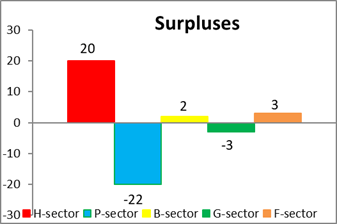
To make things as simple as possible for the 12-year-old, let us assume that the foreign sector is in balance (exports = imports) and that the government runs a balanced budget (taxes = spending). Then the chart will look like this.
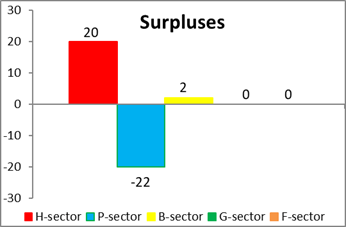
In normal circumstances, the H- sector will always be in surplus, as Householders save some of their income, and the B-sector will also normally be in surplus as bank interest income normally exceeds interest expense. It follows therefore that the production sector must necessarily be in deficit to get sum zero. This deficit must be financed by borrowing from the banks. Therefore, the P-sector’s debt will increase year after year until it approaches the value of its assets. At that point, the banks will get nervous, stop lending and the whole economy will crash.
Can you see the way to avoid a collapse? It is actually very simple. The government must run a deficit by increasing spending or cutting taxes. It might do this, for example, by providing each and every household with enough cash to cover all their medical expenses. This extra money flows primarily into the production sector to buy health products, increasing profits, and can thus bring the P-sector into balance, as shown below.

For a currency-issuing sovereign government, deficits are not only good for the economy because they prevent the business community from collapsing, they are also downright necessary. It follows from the above that the cumulative government deficits (“the national debt”) must grow year after year without limit. However, that is not an issue, as I showed in my blog “34 Trillion in Debt is NO PROBLEM”, as there is no one to pay back. This “national debt” is not a real debt that is owed to someone, but is more like a form of inert money (“the third kind of money” in my upcoming book), just an accounting entry without greater consequence.
There are several lessons to be learned here for politicians and others who misunderstand the way the economy actually works.
- Deficit hawks who go around shouting about the need to cut spending are really saying, “We have to cut business profits. Greater profits are indefensible and will ruin the economy”. That is exactly what happens when we reduce the government deficit by cutting spending—we reduce corporate profits. Want to reduce the government deficit? Then realize you are increasing the business deficit. No way around this. Is that really what you want?
- In spite of what many politicians say, a balanced government budget can be disastrous for the economy.
- It is no better to talk about the limiting the ratio of government debt to GDP. That too must increase without limit as illustrated in the case of a no-growth economy with a fixed GDP.
- Who benefits most from sending government cash to households to cover their medical expenses? THE BUSINESS COMMUNITY! Those dollars do not disappear down some dark hole. They are used to buy consumer products that increase business profits—a win-win proposition.
- The business community is entirely dependent on the public sector for its continued existence and not the other way around. The public sector has the right to demand something in return, for example, environmental responsibility and the well-being of citizens as top priorities. This is a major theme in the second part of my new book, THE BAD NEWS & THE GOOD NEWS: The Economics of Collapse and The Birth of a Regenerative Society, coming February 8, 2024.
 J.T. Ross Jackson
Leave a comment