The Weaponization of Finance.
In an early chapter of my recent book, THE BAD NEWS & THE GOOD NEWS, I described the special role played by the U.S. dollar in the global economy. That role is going to change dramatically in the coming years, and will bring about major long-term geopolitical shifts.
Since the Second World War, the U.S. dollar has been the major reserve currency of the world’s Central Banks. In the current international system, Central Banks need liquidity to facilitate trade with each other. Being the currency of the world’s largest economy, the U.S. dollar was the natural first choice due to its liquidity. It was not the only option, as the euro, British pound, the Japanese yen and a few other minor currencies also played a role, but a much more modest one.
The percentage of U.S. dollars in Central Bank Foreign Reserves has declined somewhat over the last two decades as shown in the IMF chart below.
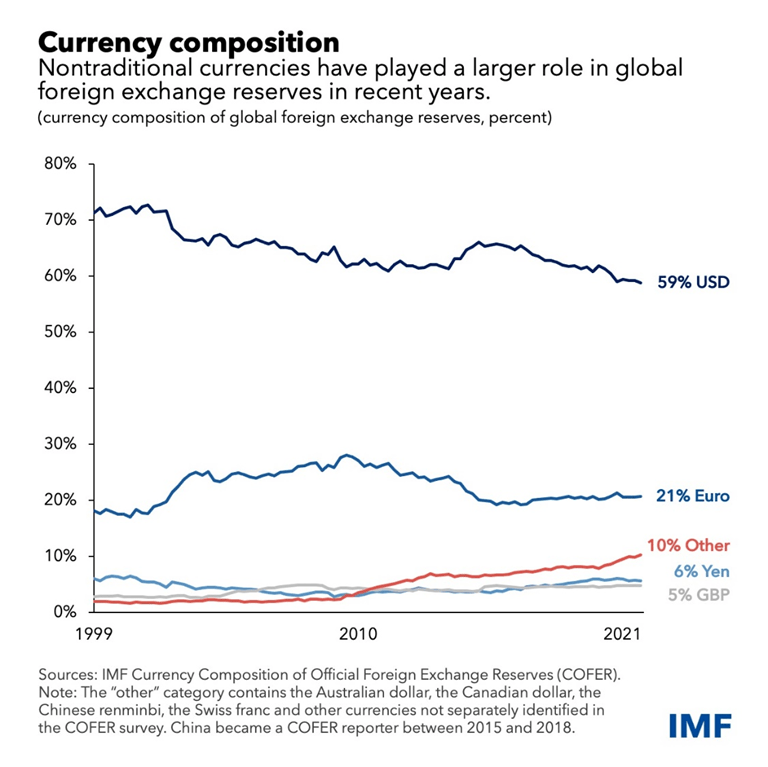
The U.S. dollar’s relative role has declined somewhat from 1999 to the present from about 72% to 59% of Central Bank reserves. The IMF explains this last two decades decline as primarily due to a modest rise in the role of the Chinese yuan, and changes in market liquidity, relative returns and reserve management enhancing the attractions of non-traditional reserve currencies.
Let me just review quickly, why Central Banks hold reserve currencies, using the U.S. as an example. The American trade deficit has generally increased since the U.S. broke the link of the dollar to gold in 1971. The increasing foreign sector surplus (U.S. trade deficit) since is due primarily to the dollar’s reserve currency status. Foreigners accumulate dollars from their export surpluses, but rather than selling them and weakening the dollar, as they would with most any other currency, they hold a good portion of their dollars at the Federal Reserve Bank in the form of U.S. Treasury Bills, which provide these foreign Central Banks with the liquidity necessary to finance their international trade. Providing liquidity is the primary role of the U.S. dollar in the current global economy. This lack of selling pressure props up the dollar, which becomes chronically overvalued, making exports less competitive than they would otherwise be and imports cheaper. For the U.S., a stronger, less competitive dollar means an even bigger trade deficit (foreign sector surplus), which means more dollars in foreign Central Bank reserves and an even bigger trade deficit, etc. etc. in a vicious circle.
Having reserve currency status has major advantages for the U.S. The overvalued dollar means the U.S. can buy foreign consumer goods more cheaply than otherwise and with its own currency, without worrying about weakening the dollar, as many of those dollars will be held as reserves and not sold, as would happen with any other country’s currency. As a bonus, foreign countries (e.g. China) get all the pollution from manufacturing those many goods for Americans.
This system worked satisfactorily for 75 years, until something earth-shaking happened in 2022 as a result of the Ukrainian/Russian war. Whether one believes one or the other of the claimed causes of the war —unprovoked aggression on a sovereign country (U.S.), or threatened NATO expansion too close to a nuclear power’s sphere of influence (Russia)—the end result was the imposition of unprecedented sanctions on Russia by the U.S. and its allies in February 2022. In particular, the freezing of $400 billion of the Russian Central Bank’s reserve assets held by the U.S. and the E.U. struck terror into the other 85% of the world whose Central Bank reserves are also held “in trust” by the U.S. and the E.U. A new mantra quickly spread throughout the Global South: “Russia today, me tomorrow?”
In the event, most of the non-Western world did not support the sanctions, partly, no doubt, for the above reason. Many turned their backs on the West’s request for help and instead helped the Russians get around the sanctions.
It is generally acknowledged that there are four necessary conditions for a currency to qualify as a Central Bank reserve currency:
- Freely convertible (i.e. not pegged and/or subject to capital controls)
- Widely accepted and used in trade and global transactions
- Backed by large and liquid debt markets easily accessible to foreign investors
- Not subject to undue political influence
In what may have been the biggest strategic mistake of the U.S. since the Second World War, they and their European allies violated the fourth condition above when they abused their role as custodians of other nations’ property by trying to shove Western foreign policy down the throats of other sovereign nations, and it did not go down well. Subsequently, the West went even further and lost even more trust. The first action was to weaponize the Western financial system by unilaterally locking Russia out of the SWIFT system for international payments. The second was the American proposal to not only freeze the Russian Central Bank reserves, but to confiscate them and use the money to arm the Ukrainians against Russia. That would clearly be an act of war. At the time of writing, this proposal has not been effectuated, as clearer heads in both the U.S. and the E.U. have warned of the possible catastrophic consequences of such a reckless action, which is not only outright theft, but could provoke a nuclear war. However, regardless of what the West decides to do, the damage has been done. The very idea of proposing such a move was a fatal blow to the dollar and the Global South’s trust of Western institutions.
The above American move was a major game-changer. The direct consequence will be seen in an acceleration of BRICS+ cooperation in the area of de-dollarization, i.e. the selling off of Central Bank dollar holdings and development of a new system of trade financed with their own currencies, or perhaps by a new basket of currencies, rather than with the dollar, and development of an alternative payments system to replace SWIFT. BRICS+ will continue to trade with the West, as their prime interest is harmonious trade and development, but they will distance themselves from the influence of Western financial markets and institutions that could be weaponized against them for political purposes, and develop their own. In his recent interview with Tucker Carlson, President Putin mentioned that Russia’s use of the U.S. dollar in financing trade dropped from 50% to 13% in just two years. The trend is just starting. One hears more and more from the long line of over 100 BRICS+ applicants that they are “tired of being bullied by the U.S.” The Global South has grown much stronger than in former times, both economically and militarily, and will in future undoubtedly show much greater resistance to Western arm-twisting than would have been possible thirty years ago.
In conclusion, the dollar will decline substantially in value, not immediately, because agreements, positions and traditions take time to unwind, but consistently over a period of some years. How much and how fast is hard to say. China, for example may not be keen on selling dollars too quickly, because that would just increase the value of the yuan, which they may not want. Then what should they do with all those dollars? I think the reason why China, and others from the Global South, are buying so much gold with their dollar reserves these days is that they can reduce their dollar exposure without strengthening their domestic currencies. But, sooner or later, we will see a general rise in the value of all other currencies vis a vis the U.S. dollar. The timing depends on several things, including whether America’s Western allies will continue to prefer to hold U.S. dollars as reserves when their trade is increasingly with the BRICS+ countries. I suspect some may even choose to join BRICS+ eventually. Foreigners hold roughly 8 trillion dollars of U.S. Treasury securities today. A major chunk of that will be sold off and/or not renewed in the coming years. The dollar will decline in value and importance, but will remain a major currency in the new multi-polar world that is unfolding before our very eyes.
 J.T. Ross Jackson
Leave a comment