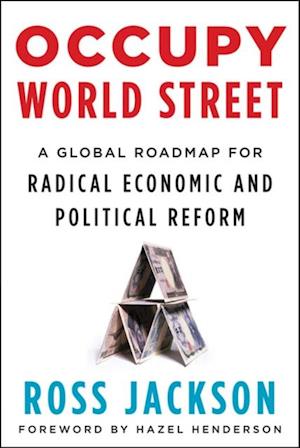
“Occupy World Street is an excellent text, even amazing. It is comprehensive, original, and very well written. Jackson’s proposal for post-collapse strategy is the first plausible, constructive scenario I have seen.” – Dennis Meadows, co-author of The Limits to Growth
Ross claims that a new “Gaian paradigm” is emerging across the globe, one that rejects the dominant but failing free market, materialistic ideology and promotes a more Life-based economic and political system that protects the environment, diverse cultures and social structures. Ross puts forward a concrete two-pronged ”breakaway strategy” to bring about the necessary reforms. The key initiative is that a few of the smaller nations take on a global top-down leadership role at this critical time in history by breaking away from the dominant and destructive neoliberal political/economic system that is leading us to disaster and replacing it with new institutions of global governance and trade that will regulate intergovernmental relations for member states, while protecting the environment, human rights and social structures in a democratic ”Gaian League” —a parallel model for a new civilization that other states are welcome to join when they are ready. The second prong is the bottom-up pressure from thousands of NGO folks in the streets demanding a referendum on their country joining the Gaian League because it stands for everything their leaders claim to believe in, but seldom execute in practice.
Buy Occupy World Street
Reviews
Further Reviews on Amazon (UK, US, DK, DE)
Agony Columns Book Review
If you think we’re living in a world of hurt, then Ross Jackson has a concrete plan that will certainly interest you. ‘Occupy World Street: A Global Roadmap for Radical Economic and Political Reform’ begins with a straightforward, well written analysis of the problems that confront us. It’s rather amazing — and depressing — but that’s the easy part. The hard part is figuring out what to do, or even if anything can be done. Jackson has that covered too, and he’s pretty convincing. ‘Occupy World Street’ seems like a fine focus for the demonstrations that call themselves “Occupy.” We might not all agree on all the details, but Jackson’s layout is impressive, concise and clear.
If you’re going to propose a solution, then you need to describe the problem, and Jackson’s descriptions are well thought out and very organized in approach. There are seven parts, with each part divided into chapters. The ecological challenges are covered in “Planet Under Siege,” the economic challenges in “Drivers of Destruction,” and the political hurdles in “The Empire.” Jackson writes with passion and precision; he doesn’t mince words, he borrows from smart established thinkers and he knows how to get the reader “het up.” He’s a great guide to the edge of the cliff.
The worth of this book is that Jackson has a set of ideas and plans to get past the cliff without exactly jumping. He’s the founder of the Gaia Trust, so the plan has a Gaian outlook, which should tell you a bit about both where Jackson comes from and where he is headed. The three remaining parts of the book map out the underlying philosophy in “New Values, New Beliefs,” set out some basic organizational tools in “Towards a Gaian World Order,” and then lay down concrete steps of how to achieve the Gaian World Order in “Getting There,” with what he calls “The Breakaway Strategy,” the title of the final chapter and the culmination of all that has preceded.
Here’s where Jackson sounds up all the pieces and gives readers a quite doable, concrete plan for getting from the current mess to a world that is sustainable and fair. Of course, different readers will have different views of the “doability” of Jackson’s plan, which involves forming a new set of world bodies to manage the environment and the economy. His plans don’t involve raging down the street and breaking the windows of those unfortunate enough to be located there.
It is utterly and consistently clear that something is really wrong today with the way the world is being run. The “Occupy” protests have done a fantastic job at focusing our attention on the problem. ‘Occupy World Street’ gives us a solution — if not the solution, certain a great set of tools with which to talk about any sort of solution. There’s a web site you can go to, but the book is going to be your key. Ross Jackson good questions, good answers and writes them well. With ‘Occupy World Street,’ reading becomes an action — but only the first action. The rest is up to you.
— By Agony Column Reviews.
Read the full review at: http://bookotron.com/agony/reviews/2012/jackson-occupy_world_street.html
Counter Punch Review
by THOMAS H. NAYLOR / March 23, 2012
Ross Jackson is an interesting guy who has just published a very interesting and timely book entitled Occupy World Street: A Global Roadmap for Radical Economic and Political Reform (Chelsea Green, 2012). Born a Canadian, Jackson has a PhD in Operations Research from Case Western Reserve University, but has lived in Denmark since 1964. Not only is he the former manager of a hedge fund, financial derivatives, currency-exchange trading firm, but he currently heads up two international NGOs related to small, sustainable, ecovillages.
According to Jackson, “The current global structure is dysfunctional, undemocratic, corrupt, and exploitive of the environment, the developing countries, and even the citizens of the wealthiest nations.” He goes on to say,
The current political leadership’s inflexible focus on economic growth makes it impossible to deal effectively with global issues like climate change, ecosystem damage, peak oil, and rationing resources. Meanwhile, millions, if not billions of ordinary citizens are dissatisfied with the status quo and are crying out for change. The dilemma seems to be: those who can, will not; those who will, cannot.
Jackson’s understanding of the economic and environmental forces underlying what he considers to be the collapse of civilization is spot on. It’s all about globalization! […]
While there may be little we can do to stop this process, there is a lot to be learned from the experience. Now is the time to begin thinking about how we want to live, love, work, play, and do business in a more localized world. It could prove to be a much more meaningful experience than life under globalization.
Jackson would replace all of the existing multinational organizations such as the UN, WTO, IMF, and World Bank with what he calls a Gaian World Order “to reflect the focus on the oneness of all planetary life in the emerging holistic worldview.”
The Gaian World Order would be launched by a dozen or so small nations which would constitute what Jackson calls the Gaian League. The Gaian League might include such countries as Bolivia, Sri Lanka, Costa Rica, Iceland, Norway, Venezuela, Senegal, Bhutan, New Zealand, Maldives, Tunisia, Mauritius, Malaysia, and Switzerland. Once established, other nations would be invited to apply for membership. The first order of business for the League would be the founding of eight other multinational organizations: the Gaian Trade Organization, the Gaian Clearing Union, the Gaian Development Bank, the Gaian Congress, the Gaian Commission, the Gaian Court of Justice, the Gaian Resource Board, and the Gaian Council. That’s a lot.
For those concerned with where life is going on the flagship earth and whether or not they want to go there, Occupy World Street is not only a wake-up call but also a call for action and a strategy for changing course before it’s too late.
Thomas H. Naylor is Founder of the Second Vermont Republic and Professor Emeritus of Economics at Duke University; co-author of Affluenza, Downsizing the U.S.A., and The Search for Meaning.
Read the full review at: https://www.counterpunch.org/2012/03/23/occupy-world-street/
Foreign Policy in Focus – Review
Occupy World Street; is an excellent primer for anyone wondering how the global economy got to where it is now. Jackson provides a pithy overview of the role of the Bretton Woods institutions, particularly over the past three decades, as well as the policy changes that allowed financial institutions to precipitate the sub-prime mortgage crash. Jackson offers something for everyone from the befuddled citizen and novice activist to the well-informed academic. Though the first half makes for a shocking and disheartening read, Jackson’s book does not wallow in guilt and despair.
Rather, Jackson deftly outlines how Lovelock’s Gaia hypothesis can be used to make the world a more equitable, environmentally responsible and financially stable place. Jackson proposes that the a Gaian Development Bank, Gaian Clearing Union, and Gaian Trade Organization must replace the World Bank, IMF, and WTO (among others). These new institutions would be based on a new Gaian worldview that incorporates the human with the natural world. Therefore, the institutions would run on a system of ecological economics that takes the limits of an ecosystem into account to better ensure economic and environmental sustainability. Other less lofty solutions Jackson proposes are increasing reliance on biomimicry, permaculture, and ecovillages. Occupy World Street, like the Occupy Movement, transcends class, culture, and educational background to inform if not inspire readers.
Read the full review at: https://fpif.org/review_occupy_world_street/
Slashdot Review (Excerpts)
Occupy World Street is a starburst of enlightenment and a practical vision of hope for a new and advanced society.
The book is subtitled appropriately “A Global Roadmap for Radical Economic and Political Reform.” It functions in a substantial way as the missing “content” for the Occupy Wall Street movement people who know that global capitalism and its political elite are screwing the middle and lower classes and the world environment but don’t know exactly how they are doing it and how to change things. The book provides an unusually lucid analysis of the American political-economic system which should make clear to the Tea Partiers what their real targets of rage should be (it’s not merely the Democrats nor the federal government.) Nearly everyone else who wants a “big picture” comprehensive analysis of the global economic system will be educated by this book.
The author, Ross Jackson, identifies who and what is responsible for the 2008 financial meltdown and many other problems in society. Most prominent are a seriously-flawed “neo-liberal economic philosophy” and the political-elite class which sponsors that philosophy for self-interested reasons at the expense of the rest of us. Jackson makes clear that economic philosophical theory is not value free and is class politics in disguise. But way more importantly than the mere class versus class struggle, the neo-liberal economic philosophy has created severe energy and environmental problems which are almost certain to lead soon to major economic and political disruptions affecting the entire globe.
Jackson is bound to be (or at least should be) hailed as a top-notch public intellectual. He is a brilliant analyst of global economics, politics, and environmental matters; and a clever synthesizer of the relevant economics, politics, philosophy, environmental science, psychology, sociology, history, physics, and biology, which apply to his examination.
He has an unusually broad and diverse background as a global currency trader, executive of a non-profit environmental organization, software designer and businessman, with degrees in engineering physics, industrial management, and operations research. This may explain, in part, his ability to see major categories of human life with such a wide lens while also being able to analyze the subcategories and the factual data.
He clearly explains how and why the 2008 financial crisis occurred and why it is likely to repeat itself, and how the current debt crisis in Europe (and elsewhere) happened and why the European Union is not equipped even now to successfully deal with it. Any effort to address it (using the existing neo-liberal strategies) will be temporary and the crises will deepen.
His discussions on the neo-liberal insistence on a deregulated economic environment, free flow of global capital, and the use of exotic financial instruments and transactions, especially naked derivatives, are the clearest I’ve read about how these elements de-stabilized the global economy. He thoroughly and lucidly explains how this political-economic philosophy destroys real democracy, including in America. What we have, he says, is a corporatocracy which dominates much of political and social life through the forces of wealth and ideology.
Mr. Jackson is a political-economic visionary of the highest order as shown in the second half of the book by his “breakaway” strategy where he sets out his alternative environmentalist paradigm. It is a new worldview emphasizing the finite reality of our natural resources, especially energy ones, and how we should alter much of what we do to comply with that reality. He argues for a new set of social values harmonious with a holistic sense of people and nature being part of one “system.” The values of that system include smallness, localization, quality versus quantity, interrelationships, and long-term perspectives.
These values are organized into a moderately sophisticated set of new global political and economic institutions modeled much like the European Union but emphasizing environmental issues and designed to satisfy long-term environmental needs. This process will also lead to enhancing of true human values in the political sphere, especially in more effective democracies.
The “breaking away” strategy starts with small nation states building a new economic paradigm based upon the environmental perspective, rejecting the flawed and elitist global institutions we have now (the WTO, World Bank, and the International Monetary Fund), and even developing new currency systems. The nation states will be supported by a grassroots activist movement which will create local eco-communities and more self-reliant economies while lobbying existing political powers to get on board with the new paradigm. The measurements of success will not be GNP or GDP but the broader-based measures of social happiness and human rights.
— Slashdot Webmaster
Read the full review and see the comments on books.slashdot.org
Occupy Oakland Review (Excerpts)
Blockbuster Book! Read about everything you ever wanted to know about the economy and the wealthy 1%, including fundamental issues that are at the core of the Occupy Movement’s list of grievances—all neatly outlined in one book, “Occupy World Street” by Ross Jackson—it’s aims and purpose and the underlying practices of how the elite 1% are enriching themselves at the expense of the 99% majority and why democracy has failed in the US; certainly a ‘Must Read’ for every person in the US.
Occupy World Street offers a long awaited plan of action for ‘the 99 percent’. Ross Jackson delivers one of the most lucid descriptions of how global financial practices are driving economies to the brink of collapse, and making it impossible to deal effectively with climate change, ecosystem damage and peak oil, trade alliances on a more human scale, and gradually replace WTO/IMF/World Bank with new institutions that support sustainable economies and uphold human rights. Rather than force a direct confrontation with the crumbling ‘Empire’, Jackson’s innovative strategy would be led by a handful of small nations that are already starting to break away from the contemporary global order, and supported by ordinary citizens around the world. Jackson has done what few others have dared to do: constructed a specific, implementable plan to reorganize the way economies work. It’s a plan, says sustainable economics pioneer Hazel Henderson that “has the potential to unite hundreds of NGOs and millions of ordinary citizens behind a simple proposal that could change the current dysfunctional game.”
Even though it addresses these issues, this book does not exude a tone of doom and gloom nor is it chalked up with radical left-wing conspiracies or propaganda. Rather, the author backs up all his claims with strong evidence and offers a road map to economic recovery and sustainability and a concrete vision for a new society, which favors not mere economic growth and greed but rather serving all of humanity rather than only the wealthy elite and “the corporatocracy”. The author, Ross Jackson, is at the forefront of this transformation—spearheading Ecovillages and offering new models for almost all aspects of civilization.
This book is neutral and not politically aligned to any party or corporation, the author states facts as they are and reveals many hidden facts that most of us in the US are not aware of, the author is wealthy and has no ulterior motives, this book is set to become a best seller. This book is no urban legend or conspiracy theory; it’s all hard facts that is not available to the general public.
— By Occupy Oakland
Read the complete review at www.occupyoakland.org
John Jopling Review
Review by John Jopling, co-author of Gaian Democracies and co-founder of FEASTA
This book asks a good question: what can we do about the fact that we live in an unacceptably unjust and hopelessly unsustainable world? It’s such a huge question that few, if any, other writers have tackled it head on, which is what this book does.
The author’s most challenging view is that the necessary transformation cannot happen unless we establish a new international framework designed to regulate intergovernmental relations in a Gaian world order. This is envisaged as a world of many self-determining, cooperating small sovereign states under a common umbrella of protection of the environment. States […] would delegate a degree of sovereignty to a global governance body responsible for ensuring long term sustainability of the planet and the observance of human rights in all members states. This should be the long term goal. In the meantime what we can do is to design the institutions that would allow such a Gaian world order to evolve.
This is an important book, a tough read perhaps, some of which you may or may not agree with, but a clearly thought out and well written analysis of the extremely grave state we are in and some clear proposals about what could and should be done to change the system as a whole. Most commentators, having described the current situation and what needs to be done about it, throw up their hands and say: what’s missing is the political will. That leads to campaigns to persuade governments to act. The end result is that the trends continue inexorably. Jackson, by contrast, says: humanity has a problem, let’s analyse it, decide on a plan and then implement it. There are enough Cultural Creatives in the world to make it happen. It’s a response one can only admire. As the author writes in the Afterword, “A bold initiative is necessary to shake up the logjam that is preventing global solutions from emerging in our contemporary world”. This book proposes such an initiative and ends with an invitation to readers to join it via the website he has set up for the purpose www.occupyworldstreet.org.
Publishers Weekly Review
Ross Jackson, chairman of the Danish-based foundation Gaia Trust and co-editor of Gaian Economics: Living Well Within Planetary Limits, provides a comprehensive and lucidly written history of neoliberal economics and its effects, tracing the inequalities inherent in neoliberal economic planning. Neoliberalism, as Jackson illustrates, isn’t an inevitable historical development, but rather an “artificial construct” created by people with a self-serving strategy that neglects the rest of humanity.
Jackson presents the fundamental flaws in modern economics, locates the turning point in regulation and economic behavior, and then shows how and why things have devolved to their current state through the actions of the IMF and WTO. He traces a new, emergent worldview, proposing a solution in the form of a Gaian economic system, in which smaller, decentralized, diverse communities with a degree of local democracy form the proposed utopia, in contrast to the branded neoliberal free market of corporate dreams.
A return to a simpler, more satisfying, and sustainable lifestyle is both necessary and inevitable, Jackson argues. The book is a how-to, “get serious about survival” guide, laying out a “global governance structure” and providing us with several strategies to try to get there. Hopefully, Jackson’s ideas won’t fall on dead ears. (Mar.)
Read review of Occupy World Street at Publishers Weekly
Praise
“Occupy World Street is a masterpiece which deserves to get wide circulation and commitment by world leaders.”
– Maurice Strong, Secretary-General of the UN Earth Summit, Rio 1992.
“Occupy World Street is an excellent text, even amazing. It is comprehensive, original, and very well written. Jackson’s proposal for post-collapse strategy is the first plausible, constructive scenario I have seen.”
– Dennis Meadows, co-author of The Limits to Growth
“Many writers have inventoried the unfolding disasters that threaten the human future. Ross Jackson is one of the very few who goes on to spell out a visionary, yet practical, program of sufficient ambition to achieve a positive future. This is a truly important book.”
– David Korten, author of Agenda for a New Economy
“Occupy World Street! is a monumental and inspirational call to action — and a long-awaited blueprint for how the actions should be implemented.”
– John Perkins, author of Confessions of an Economic Hitman
“The Occupy World Street initiative has the potential to unite hundreds of NGOs and millions of ordinary citizens in the streets behind a single simple proposal that could change the current dysfunctional game.”
– Hazel Henderson, author of Ethical Markets: Growing the Green Economy
“Ross Jackson’s reform proposals for our global institutions are more than astonishing-they are mind-blowing-pure creative genius. Let’s do it!”
– Clinton Callahan, author of Directing The Power of Conscious Feelings
“Brilliantly informative, timely and prescriptive, this book has global solutions for the Occupy movement. Simply the best strategy I have seen, and because Jackson himself started with grassroots community seeding, his strategy is well grounded. So spread this book and get going!”
– Elisabet Sahtouris, author of EarthDance: Living Systems in Evolution
“Ross Jackson, who is one of the world’s wise elders, describes a range of new global institutions that can give birth to a world of sustainable prosperity.”
– Duane Elgin, author of The Living Universe
“Ross Jackson has written the definitive analysis of why the current system cannot reform itself and why a completely new system must be born.”
– Jim Garrison, Chairman and President, State of the World Forum
“If you have seen the Occupy Wall Streeters but can’t quite fathom either what they are trying to say or how they might actually succeed, Ross Jackson has something to tell you.”
– Albert Bates, author of The Biochar Solution
“A brilliantly detailed template for how to materialize enlightened global society.”
– Llyn Roberts, author of Shapeshifting into Higher Consciousness
“Occupy World Street is a profound and urgently needed roadmap for the future of human civilization”.
– Will Keepin, author of Divine Duality
“Ross Jackson offers practical solutions to the course correction so sorely needed today.”
– John Renesch, author of Getting to the Better Future
“Occupy World Street is an important, timely and courageous piece of work”.
– Thomas H Greco Jr., author of The End of Money and the Future of Civilization
“Ross Jackson presents us with an extraordinary global plan to tackle the multiple crises of our times-awesome in conception, sensitive in detail, and realistic enough to succeed.”
– Richard Register, author of Ecocities – Rebuilding Cities in Balance with Nature
“Ross Jackson has been both a successful financier and an inspirational grassroots innovator. This new book brings his wealth of experience to bear in a powerful and pragmatic response to our social, ecological and economic malaise.”
– Helena Norberg-Hodge, author of Ancient Futures
“Occupy World Street provides both a brilliant analysis of the immanent dangers that threaten to lead to a collapse of our global civilization and a bold and visionary design of a global governance that embraces local sovereignty within an international framework for stewardship.”
– Peter M Pruzan, co-author of Leading with Wisdom
Quotes
Here are a few selected statements from the book to give the reader a taste of the content.
If the objective of someone was to drive our civilization to ruin, nothing could do it more effectively than the invention of the currently dominant economic system—neo-liberalism.
—–
The basic problem is that the eurozone structure was poorly designed from the beginning——from day one it was only a question of time before a crisis developed.
—–
Therefore, I will go on record again with the pretty much the same statement that I made over ten years ago. The current global financial system is systemically unstable and flawed and continues to be an accident waiting to happen.
—–
More than any other country, the United States stands to benefit from a shift to a more egalitarian society, resulting not only in better average health and fewer social ills, but in tremendous reductions in health care expenses and the costs of treating the symptoms of social dysfunction.
—–
The overriding objective of effective global governance in a Gaian world will be to ensure survival of the human species—an objective that is beyond ideology.
—–
The WTO rules are nothing less than a frontal attack on the welfare state and the environment, making them one of the major drivers of destruction.
—–
The reality is that without the availability of cheap resources and cheap labor from the 100 or so developing countries that are financial colonies of the dominant Western powers, the standard of living in the rich countries could not possibly be sustained, and the Western elite knows it.
—–
The USA’s elected leaders seem to live on a different planet and have no choice but to lie to the people and basically ignore their wishes due to the influence of their business bosses. This is the major failure of democracy in our time.
—–
What has happened over the past decades is that political power in the United States has been transferred to a sociopathic “corporatocracy”.
—–
All financial crises can be explained by some combination of these three—deregulation, unrestricted capital flows, and naked derivatives.
—–
There can be little doubt that we are on a journey toward a different kind of world for the simple reason that this one is on an unsustainable path.
—–
If the Gaian League should degrade into just another international organization to promote and protect the interests of the founders, then the project will fail.
—–
My approach is radical in the original sense of the word—dealing with the root of the problem. The root of the problem is that not a single country on this planet takes ecological sustainability seriously.
—–
A majority of the members of the United States Congress no longer represent the people, but rather their corporate backers, who have a very different set of priorities.
—–
Whatever the outcome of the ongoing European sovereign debt crisis, it will be nothing like the coming energy descent crisis, which will be far more serious.
—–
“Poverty” should be seen not so much a function of material possessions as a matter of perception of one’s social status. The way to reduce poverty is not to increase average income, but rather to change perception.
—–
In spite of spending more per person on health care than any other country, the United States has by far the worst score on the Index of Health and Social problems.
—–
The Neoliberal Project is intentionally preventing the developing counties from developing. The last thing neoliberals want is competitive developing countries.
—–
The historical record provides strong evidence for the argument that the United States can no longer be considered a democracy, except in the narrow sense of formal elections.
—–
A business administration student that considered part of the invested capital as yield would flunk his exam—yet this is precisely what economists do when arguing the benefits of industrial agriculture as opposed to organic farming.
—–
The last thing the West wants to see is developing countries running their own economies the way they want to, growing sustainably and equitably and, in general, running their countries according to their own priorities.
—–
Marxism, for example, can be seen as a particular form of capitalism with a focus on who owns the means of production.
—–
In Joseph Tainter’s language, the marginal costs have exceeded the marginal benefits for about thirty years in the United States, suggesting that a collapse may have begun already back in the 1970s.
—–
A fatal energy trap could condemn humanity to become a permanent subsistence civilization if we are not very careful with how we use the remaining fossil fuel resources.
—–
The reality is that we are heading for a major economic crisis in a few years, with demand for oil permanently exceeding supply and with the shortfall increasing year after year.
—–
The failure of the 2009 and 2010 UN Climate Conferences to deal decisively with the looming danger of climate change raises a worrisome thought—it may not be politically possible to deal with the many global crisis that our civilization faces.
—–
Economics has always served its political masters.
—–
The dilemma seems to be: those who can, will not; those who will, cannot.
—–
It is absolute rubbish to claim neoliberal economics to be inevitable. If anything is inevitable, it is the opposite, steady-state economics, without which our civilization is unlikely to survive
—–
It is probably too late to avoid a collapse of civilization as we know it due to an obsession with economic growth on a finite planet that cannot tolerate much more without collapsing.
 J.T. Ross Jackson
