“Ross Jackson reminds us that the collapse of the growth-for-growth’s-sake global industrial economy is not the collapse of the world as such. Indeed, as this book shows, it is an opening onto a renewed ecological economics of place, one the world and our hearts are desperately crying out for.” – Helena Norberg-Hodge, author of Ancient Futures.
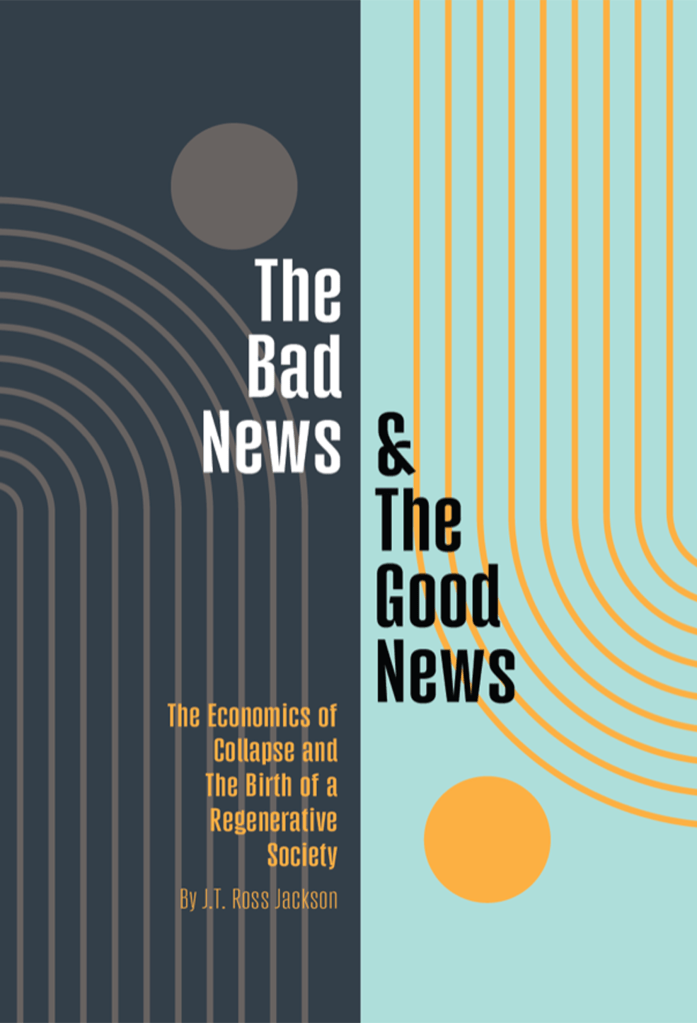
This book is a sequel to Ross Jackson’s previous book, Occupy World Street: A global roadmap for radical economic and political reform (Chelsea Green, 2012). Both books are about global governance. Where the first book dealt with the international aspects, including eight proposed new international institutions, the latter deals with the nation aspects, with a primary focus on the economic system.
In the first half of the book—The Economics of Collapse— Ross Jackson makes the point that the economic system is the most important single determinant of the success or failure of a society. He explains why the premises of the current economic system had to lead to collapse sooner or later, and exposes a number of widespread false beliefs about how the economy really works. Among other things, he illustrates that the national debt in not a burden; that the corporate sector would collapse if the government did not run a chronic budget deficit; that there are actually three kinds of money; that the Quantity Theory of Money is false; that a sovereign state does not have to borrow money. A more correct understanding of economics is necessary for the design of the post-collapse society. Jackson’s conclusions are backed by statistical analysis of 72 years of U.S. economic data and his own dynamic macroeconomic model built with standard economic assumptions supplemented by his own original research.
In the second half of the book—The Birth of a Regenerative Society—Ross Jackson describes the kind of society that must evolve if we are to leave Nature’s capital intact while living off its annual yield for as long as the planet is habitable—millions of years. As there will be a ceiling on the amount of production, population will have to be smaller and controlled. Increased labor and resource productivity will mean fewer and fewer working hours will be required to survive in this high technological but sustainable world. Maximizing well-being for the great majority will require the common ownership of land and resources. This egalitarian society will have a focus on living in community as opposed to individualism, and on localization as opposed to centralization. It will of necessity be a carbohydrate society with the great majority of products being plant-based, as was the case prior to the “fossil fuel age”. The economic system will be a form of “managed capitalism” to allow creativity and economic progress while limiting the extent of damaging production with the use of wealth taxes and “stakeholder management” of the corporate sector. The latter will require a universal public banking system to control social and environmental costs through selective taxation and interest charges on the corporate sector, including local currency systems to promote regional development. Getting money out of politics will require a new kind of democracy. Jackson suggests a “pyramid democracy” system based on politicians that are all elected by their local communities across the globe and kept in line with an “Ethical Council” that can intervene to eliminate corruption and greed. Healthy food will be produced by “regenerative agriculture” based on the preservation of soil, agroforestry, permaculture, no till, no artificial fertilizer, and no pesticides. Local ethanol production from non-edible high sugar plants like kelp, mesquite trees and bullrushes will provide heat, electricity and fuel with organic fertilizer as a byproduct.
This multipolar society will evolve within a framework of global cooperation based on the eight international institutions described in Occupy World Street and the national institutions described in this book. The international aspect of the successor society is summarized in a single chapter of this book.
Praise
“Ross Jackson has done it again, this time with another splendid book-length
thought-provocation on the future that can await us, where we live, on the other side of the current failing civilisation.”
—Rupert Read, Emeritus Professor, author of This Civilisation is Finished.
“Ross Jackson reminds us that the collapse of the growth-for-growth’s-sake global industrial economy is not the collapse of the world as such. Indeed, as this book shows, it is an opening onto a renewed ecological economics of place, one the world and our hearts are desperately crying out for.”
—Helena Norberg-Hodge, author of Ancient Futures.
“With masterful simplicity, Ross Jackson penetrates the complexities of our
unsustainable economic system and offers a deeply insightful exploration of a
pathway toward a livable and compassionate world. This wise and helpful book
balances understanding of the destructive aspects of economic growth with mature realism for the world that we have the capacity to create.”
—Duane Elgin, author of Voluntary Simplicity, Choosing Earth, The Living
Universe, and other books
“Ross Jackson’s book describes a world that is getting worse and worse better and better faster and faster. We are simultaneously experiencing global economic and political collapse while new forms of regenerative economies and democratic institutions are being envisioned and implemented. This is a must read for anyone wanting to skillfully navigate a world made turbulent by both the demise of the old and the rising of the new.”
—Jim Garrison, President, Ubiquity University
“Ross offers an illumined path through chaos placing nature, and our true human nature, at the forefront. He clearly outlines where we are now, and how to create a harmonious future.”
—Llyn Roberts, award-winning author and founder of the Olympic Mountain
EarthWisdom Circle
“Ross Jackson’s new book is a precious treasure map to a brighter future for
humanity. If any national politician fails to read THE BAD NEWS & THE GOOD
NEWS, or fails to comprehend the regenerative economics that Ross Jackson
provides in these pages, then they will continue to implement archaic thoughtware, and the catastrophic collapse of western civilization.”
—Clinton Callahan, originator of Possibility Management and author of Conscious
Feelings.
“Italian political philosopher, Antonio Gramsci, famously remarked that ‘the old world is dying, and the new world struggles to be born’. In this period of transition, the myths and metaphors that underpin the dying world come under irresistible strain as more congruent stories emerge. Ross Jackson in his latest book, The Bad News & The Good News: The Economics of Collapse and The Birth of a Regenerative Society, succeeds admirably in both nailing many of the foundational myths that provide the intellectual scaffolding of the dying paradigm that is neoliberal capitalism and in mapping out a new vision for the world that is already in the process of being born.”
—Jonathan Dawson, Head of Economics, Schumacher College.
Quotes
Here are a few selected statements from the book to give the reader a taste of the content.
—–
We are apparently in the 7th decade of our collapse at this time (2020s)
—–
Three fundamental flaws in the practice of economics—with the complicity of the
political elite—has “hard-wired” our civilization for collapse. They are (1) failure to
incorporate environmental and social costs—as required by economic theory— in
economic practice, (2) the assumption that humans are solely motivated by self-
interest and the accumulation of wealth, (3) The goal of unending economic growth
on a finite planet.
—–
Therefore, I will go on record again with the pretty much the same statement that I made over ten years ago. The current global financial system is systemically unstable and flawed and continues to be an accident waiting to happen.
—–
Banks create credit money out of nothing! No liquidity is required. No existing
savings deposits are required.
—–
In a simple Production/Bank sector economy, there is no way interest or capital on
bank loans can ever be repaid and the economy will eventually collapse.
—–
A global balanced budget will eventually lead to collapse of the global economy as
there is no money to pay interest on loans, let alone capital. A government sector
deficit is necessary to prevent the collapse.
—–
The national debt is not a burden on current or future generations. The domestic
debt (outstanding government securities) can be paid back at any time in a simple
liability swap.
—–
There are actually three kinds of money with different functions (1) bank credit to
finance the real economy (2) speculative money placed in existing assets, and
derived primarily from householder savings, and (3) “inert” money (bank reserves)
with no interaction with either the real or speculative economies.
—–
The Quantity Theory of Money can be shown to be false, both logically and
empirically. Inflation is not caused by excess growth in the so-called “money supply”.
—–
My model, supported by empirical analysis as well as other studies, suggests that
government spending is not inflationary.
—–
Taxation should be used primarily for two things (1) forcing corporations to pay for
social and environmental damage caused by production (2) controlling income and
wealth distributions through increased capital gains and wealth taxes.
—–
A regenerative society requires a new worldview that resonates with our fundamental essence. Otherwise, it won’t survive and thrive.
—–
Regenerative agriculture is the one form of agriculture than can last forever because it prioritizes nature’s own methods, including maintenance of soil integrity, no till, biodiversity, agroforestry, no artificial fertilizer and no pesticides or herbicides.
—–
The most important single economic reform suggested for a nation of the emergent regenerative civilization, assuming that private banks still exist there, is the nationalization of all retail banks into public banks.
—–
The successor economy, which must respect Nature’s limits, will be characterized by limits on production and population.
—–
The coming regenerative society will revert to carbohydrates, which are cheaper and just as effective, and ban the burning of fossil fuels, with few exceptions.
—–
A major innovation in the new economy will be the control of income and wealth
distribution to meet the accepted norms agreed upon.
—–
A new dual political structure, including an ethical council, is suggested to replace
traditional democratic elections, which led to alliances between politics and wealth to the detriment of citizen well-being.
—–
A.I. can only handle problems with a quantifiable criterion function, which is rare in
the real world.
—–
Perhaps the only feasible path to a regenerative civilization is through the collapse of an unsustainable society and a rebirth based on sustainable principles.
 J.T. Ross Jackson
